I study how descriptions of dense matter become macroscopic signatures in compact stars, using computational and statistical methods chosen to serve the physics.
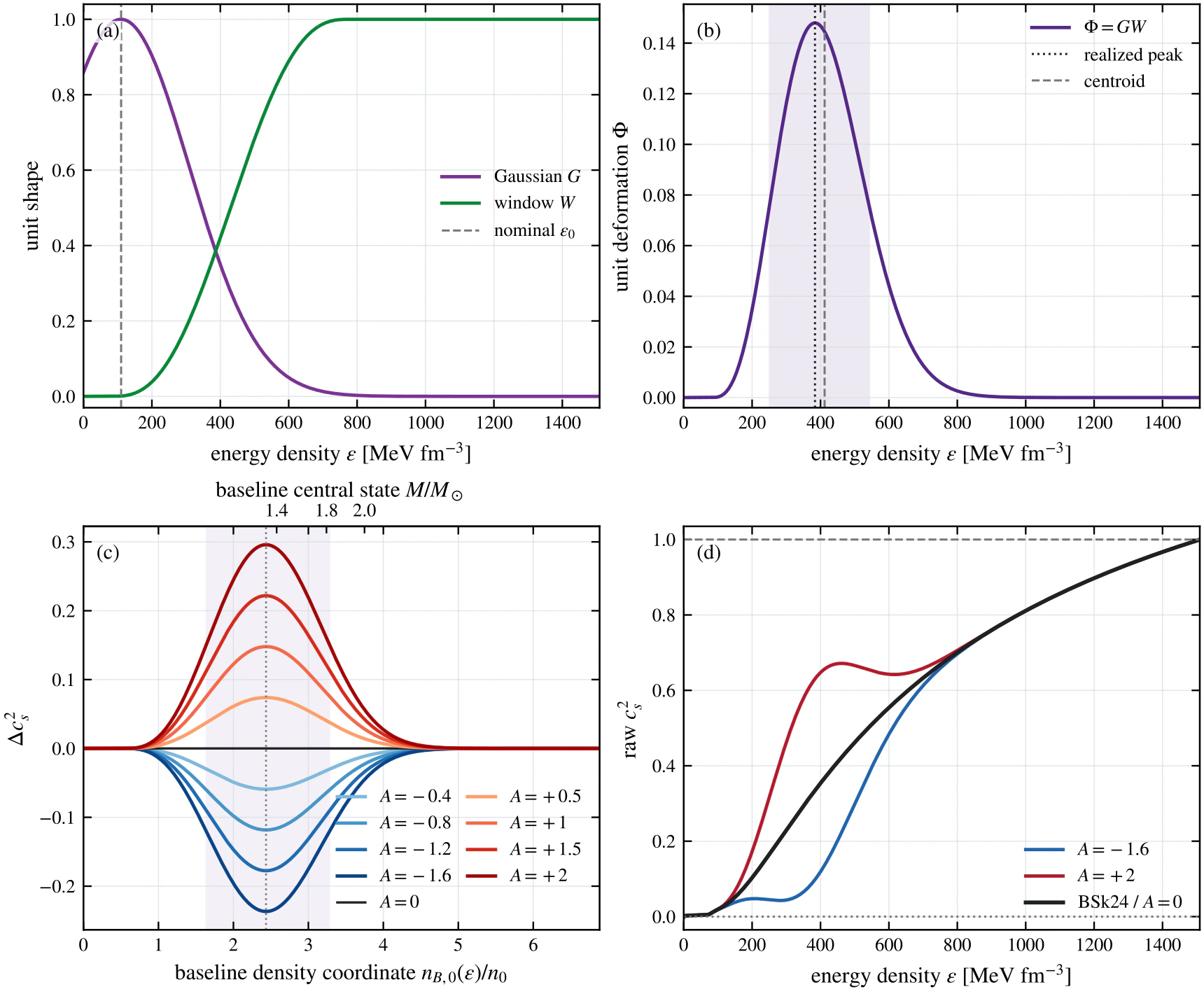
Current focus: controlled sound-speed deformations of analytical BSk24, with thermodynamic admissibility assessed before one-fluid reconstruction and stellar calculations.
My current work asks how a controlled change in a dense-matter model survives thermodynamic assessment and appears in macroscopic compact-star observables.
Realized deformation geometry for the fixed BSk24 campaign. This is a controlled effective deformation, not a microscopic composition model. Figure: Ioannis Papathanasiou, campaign data v1.0.0, CC BY 4.0; web-optimized from the released PDF with scientific content unchanged.
Current method · analytical BSk24
A controlled perturbation with an auditable path.
01
Define
Introduce a local signed sound-speed change above a retained anchor.
02
Assess
Reject inadmissible raw proposals before any reconstruction or stellar work.
03
Propagate
Carry accepted cases into one-fluid thermodynamics, structure, and tides.
The BSk24 study now leads with its sole-authored arXiv preprint, released software, and campaign evidence. The thesis case study remains distinct and shows how a later methodological review narrowed the defensible classification claim.
01
Research and reproducibility 2026–present
Signed BSk24 sound-speed deformations
A controlled study of how positive and negative local sound-speed changes propagate through thermodynamic reconstruction and into fixed-mass neutron-star structure and tidal response.
Sole-authored arXiv preprint · software and campaign data public
02
Undergraduate thesis 2026
Compact-star model discrimination
An undergraduate synthetic study of hadronic-star and self-bound strange-quark-star model discrimination, followed by a stricter audit of what the classifier can support.
Thesis examined in 2026; distinct post-thesis redevelopment documented
Interactive demonstrations
Explore the restricted classifier workflows.
Two independent post-thesis applications make retained synthetic model scores interactive. Their assumptions and scientific interpretation boundaries remain visible before launch.
Baseline demonstration
APR-1-surrogate versus fixed-CFL4 scores
Explore selected mass, radius, and tidal inputs inside one restricted synthetic comparison—not an observational composition inference.
A result is more convincing when its assumptions, numerical behaviour, and limits can be inspected. Reproducibility and validation are built into the method from the start.
01
Start with the physics
Define the system, relevant scales, and scientific question before choosing the machinery.
02
Make the model explicit
Expose assumptions, domains, anchors, and admissibility conditions.
03
Choose the tool
Use numerical, statistical, or machine-learning methods only where they resolve the physical question.
04
Validate the claim
Test sensitivity, preserve provenance, retain failures, and state the interpretation boundary.
Education
Physics, AUTh
Degree in Physics, Aristotle University of Thessaloniki, 2026 · 240 ECTS · 8.46/10 (“Very Good”). Undergraduate thesis: 10/10.